Fish Bones

I used to run barefoot through the grass and trees on summer evenings to watch the sun sparkle on the river behind our house. Sometimes, I would run there when the sky was cloudy and the waters gray, just to sit on my rock alone. Once, you tried to join me but I got mad and said you couldn’t. I wanted it to be my spot. I carved my name, “Sabrina,” with pebbles into the rock by the river’s bed, and replaced it every time the rain washed it away. 

I didn’t want my mother there. But it was lonely sometimes. Until one day, a pearlescent fish sprang out from the water, its scales catching the sunlight and flickering with prisms of color— violet, and mossy green, a flash of honey yellow and ethereal blue. When it jumped, an arc of water trailed behind it like strings of crystal. 

At school, I leafed through books to find its name. I colored pictures of the fish for my teacher to identify, but this fish remained unmatched, a mystery every time it broke the river’s surface. It moved unlike any I’d ever seen, so fluid and light, jumping as if it might fly.

I began to dip my feet into the river where it slowed and gathered into pools around my rock. I was hoping to catch the fish’s attention, but it took a long time. Finally, one day, the fish came to me. I marveled at its beauty, its gem-like scales and delicate fins. 

“What’s your name?” I asked, but it didn’t respond at first. It was a shy fish. It had taken a week of dipping my toes into the water before it came to me. Finally, though, it answered.

“I don’t have a name,” it said. Its voice was cheerful, like splashing water, the sound of it confirming my budding suspicion that this fish was magic. “How do I get one?” 

“Someone gives it to you,” I explained, feeling very wise. 

The fish seemed to ponder that, its marble eyes watching me, its mouth a pleasant grin.

“It doesn’t make sense, does it?” it asked. “Why can’t you choose your own name?” 

I laughed. The fish was right. And I never liked my own name. 

“What do your friends call you?” I asked. The fish swayed in the water, its glowing fins drifting.

“I don’t think I have any,” it said. 

Maybe we were very much alike, I thought to myself, even though it was a fish and I was a person.

“Well,” I said. “I’ll be your friend.”

The fish’s eyes sparkled.

I visited everyday, telling it about life on land, and asking about life in the water. I shared the name of the river, Severn, because it had become ours, and I didn’t mind sharing my spot then. 

I spent the whole summer running off to the river every chance I could. Sometimes, you would get mad at me for disappearing so much. I thought you just didn’t understand. And how could you?

Then, one scalding summer day, Dad brought Jeffrey fishing in the river.

I woke from a nap and came downstairs to find my fish lying dead and cooked on the dinner table. 

Its eyes were gouged out. But I recognized its shape, its once beautifully shining scales charred and covered in spice, its mouth gaping.

I wailed. Murderers. I screamed. 

You tried to calm me down. You used to tell me to take a deep breath, and as I let it out, to turn my body in a circle. When I was older, you explained this was a grounding technique to distract from negative emotion. But back then, I didn’t know what that meant. I told you it was stupid. I didn’t want to play your psychology game. I wanted my fish back. 

Dad laughed about the whole thing. 

“There are plenty more fish in the river,” he said. 

When I cried that this one was my friend, Jeffrey made fun of me.

I refused to eat any dinner that night. When the table was cleared I went through the garbage and collected my fish’s skeleton. I brought the bones to my room and whispered to them.

“I’m sorry I was not a good enough friend.” I tasted the salt of my tears as they wet my mouth.

Then, when everyone went to sleep, I snuck out the door and into the woods. The moon was bright and the river glistened with silver. I knelt on my rock and placed the bones into the water. 

I tried to talk to my fish how I always did. I wished the bones would reassemble, that its scales would grow back and it would swim again. But nothing happened. 

Maybe the water was too cold. I panicked. Maybe I should take the bones back out.

Yellow lights flooded through the trees and behind me, silhouettes of you and dad moved inside the house. Your shadows looked frantic. I ran back so you wouldn’t be worried, but I could hear you yelling at each other from the front porch and wished I stayed with my fish. 

That was a year before you divorced. I thought the whole time that it was because of me, because I had made such a big deal about the fish. Jeffrey accused me of such, and years later, even from afar, I still believed it. I shouldn’t have run out in the middle of the night. I shouldn’t have cried so loudly. It was a waste of time anyway. I returned to my spot so many times, hopeful, longing for the beautiful creature that understood me, but it was gone. Its bones lingered for a while like pale ghosts, until they drifted away in the current. No other fish came. The bones must have scared them. Eventually, I grew up and stopped looking. I tried to make other friends, but they often eluded me too.  

I was twenty-eight when you died. I returned to that house to try to stop it, but all I could do was watch as it consumed your body. I held your hand as your skin turned yellow, and your bones jabbed out as you gasped for air. 

Ruthless disease. It didn’t make sense, to have no cure, to have a problem with no solution. I wanted to save you. And when I couldn’t, I wanted to at least soften it. I remembered your technique of breathing, then turning in a circle during exhalation. But you couldn’t sit up on your own, or breathe without tubes in your nose. 

The day before you died, your eyes lit up one final time as I put the useless pills in your palm. 

“You were such a happy child.” From that whisper I knew, in one rising moment, your divorce wasn’t my fault. 

When you were gone, the arguments resurged. Dad arrived, that blonde he remarried hovering behind him, and decided cremation, even though I told him you wanted a wake and burial. In the end, I helped choose the urn. The services were performed, your long-estranged family from the UK dispersed, and I was left in the empty house surrounded by white lilies in various stages of rot, piles of condolence cards, and empty boxes of pizza. 

Jeffrey had listed the house for sale, leaving me to clear everything out. So much to sort, to pack, to throw away, but all I could do was nothing. I stared at the urn, a foreign emblem of you. It looked offensively ugly then, although an urn would be a strange thing to ever call pretty. I passed it everyday that week, the grief pitting inside me like poison, until one evening, when the sun began to fall and cast sparkles over the rippling river, I brought your ashes to the water. I don’t know why. You hadn’t asked me to. 

It was a dry summer and the river was thinner than I’d ever seen it. 

I stood at my old spot, the rock I wouldn’t let you come to, the name I had carved long since worn away. I poured your ashes into the water where it pooled. I would gladly share my spot with you now.

I lingered there, as you churned then dissipated, the muted sounds of trickling water and rustling leaves echoing the past. The river flowed on as if nothing had changed since then. But there were fewer trees now. Across the river developers had cut some down.  

I slipped off my shoes and stepped into the stream beside my rock, the water cool on my toes. 

It crashed like a wave, a force both hollow and enormous. My chest tightened and stifled my breath, and my sweat-slicked skin prickled. I crumbled to my knees in panic. I had no Xanax with me.

Just then, the water’s surface broke and a fish jumped from the river, a crystalline trail cascading behind it. Pearlescent scales shimmered in the evening sun. I leapt up, afraid to lose sight of it. But I didn’t have to worry. The fish came to me, swimming by the river bank. 

Could it be? I nearly laughed at my foolishness. My memory was foggy from so long ago, buried away with a long forgotten imagination. But it did look the same.

It had the same sheer fins, the same silver tipped scales that had colored my dreams as a child. That fish had seemed bigger though. I guess everything did back then.

The fish didn’t talk. It lingered near me, in the spot where I poured your ashes, the spot where I had left the fish bones in the darkness so many years ago.

Through my water-warped reflection, the fish’s eyes sparkled with sunlight, its fins fluttering, waiting for something, watching me. Then it rose, gently touching the surface with an open mouth, before drifting back. 

Deep breath. Then, as if carried by an invisible current, it swam in a circle. Bubbles rose from the fish’s mouth like orbs, breaking the surface between us. Exhale.

I whisper your name. 

A calm breeze cools the tears on my face, and one drips into the river that carries you away. 

THE END
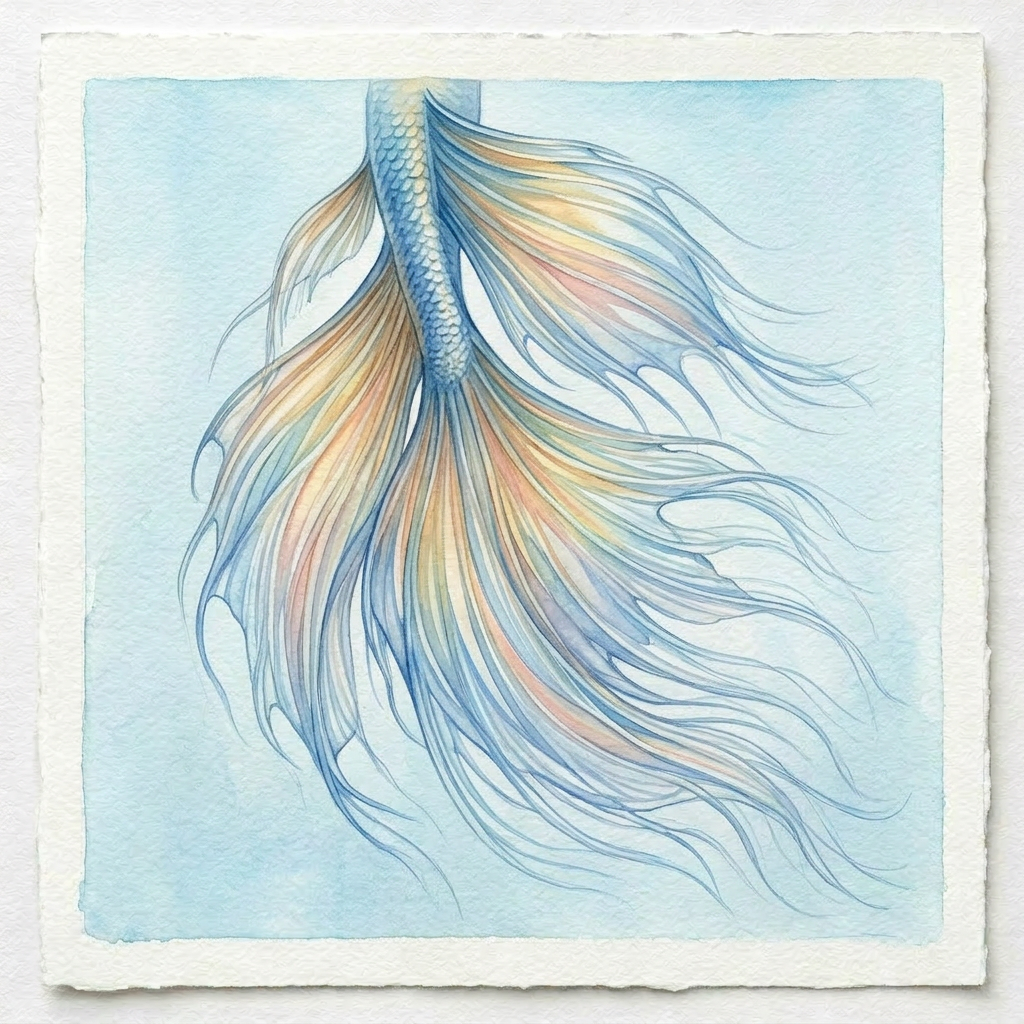
Watercolor painting of a goldfish with blue and orange fins against a light blue background

SERPENTINA Chapter 1

SERPENTINA Chapter 1

1

Dark leaves rustled in the forest, their dried tips rubbing against each other like the slow rattle of a snake. Emma paused, a warning echoing in her mind. Since her arrival to the reptile research base on Crete, she had ventured into the palm forest alone each afternoon, wandering deeper each time.

Never enter the forest alone. It was the rule her research mentor emphasized most during orientation. But there was nothing truly dangerous on the island. Hercules had cleared away all the deadly creatures to honor Zeus’s birthplace. She smiled, recounting the myth the airport taxi driver had told them. Emma knew, out of all the snakes there, only the cat snake had venom, and it was too mild to hurt a human.

Still, if Dr. Belken discovered her sneaking out at dusk, she might as well kiss a Columbia University recommendation letter goodbye. Yet the forest called her in, beckoning her to explore its ancient grounds.

She stepped over sandy soil, glancing over her shoulder at the wooden stairs and scanning to see if anyone was watching before turning into the trees. She savored a breath. The air was dry and the heat tame, with an endless breeze carrying wisps of sea salt and the spice of wild herbs through the dancing shadows of leaves.

A rustling halted her steps.

Her eyes darted to catch a beige, reptilian tail slipping into the nearby shrubs.

She held her breath and crept toward it, afraid to scare it off. It would sense the vibration of even her lightest step.

She peered through a thicket of narrow, glossy leaves and clustered pink flowers. Her heart pounded, instincts heightened, but she reminded herself that even a bite couldn’t kill her.

At first, she didn’t see anything. Then scales materialized among the leaves on a thick, coiled body. Only now they were green and pink. She squinted. Was it a different snake, or had it changed?

Its serpentine head emerged through the leaves, forked tongue flickering. She froze.

This was not a cat snake.

Images of the other native snakes raced through her mind. She was good at identifying them. This didn’t match any. With all the travel to and from the island, she supposed it could be an invasive species. Her heart pounded faster and sweat broke on her brow. It could be venomous. And she was alone.

To her relief, the snake slid through a patch of tall grasses and emerged on the far side. Her eyes widened in disbelief as the scales changed back to beige as it slithered over dried leaves.

She slid a trembling hand into the pocket of her capris, then took a picture with her phone. A closer one would be better. She held her breath and stepped again. A dry leaf crinkled underfoot, and the snake’s head snapped in her direction. Its eyes flared as they set on her, hungry with anger.

Predator’s eyes.

Heart drumming, Emma turned and sprinted back to the base. She burst into the atrium, bending over to catch her breath.

“It appears I have to go over the rules with someone.” A voice from the side doorway made her jump.

“Dr. Belken!” She faced her research mentor, chest heaving.

“Do you realize what trouble your wanderings could get me in?”

She nodded, grasping for words to explain herself. When he had warned of dangers, he meant strangers who might prey on a young foreign girl wandering alone. But the forest was gated off for research and far away from the crowded city center, where an occasional pickpocket might lurk among the seaside cafes and street vendors selling figurines of the Minotaur. Emma was annoyed by the warning that a boy her age could go pretty much anywhere without.

“So,” he said, his eyes glistening. They reminded her of an owl’s, both wise and threatening. “Did you find anything?”

Relief flooded her that she might actually escape this without any repercussions. She nodded, her mouth dry. “A snake,” she said. “But I couldn’t identify it.”

He placed his glasses on. “Where?” he asked. She pointed. “Let’s go,” he said without hesitation. She lingered, the final traces of daylight now slipping from the sky, and wondered if he’d be insulted if she warned him.

She described the snake’s changing patterns as they paced toward the ferns, and she felt a slight relief having him there. His tall, lanky frame didn’t offer much security, but surely he could identify the snake. He wouldn’t put her in danger, would he?

But when they reached the ferns and searched the underbrush and surrounding trees, the snake was gone.

Or at least they didn’t see it.

She quickened her pace as they headed back, recalling how seamlessly it could conceal itself even in daylight, and tensed with each step, poised for it to strike from the earthy shadows.

*

Emma locked her legs around her friend’s shoulder in a jiu jitsu hold as they rolled over their cabin floor the following morning.

“Okay, okay,” Pria said, tapping Emma’s hip. She released her, and Pria wiped long, silken waves from her sticky face. “Can we be done?” she asked. “We have lab samples to go through.”

Emma nodded. “Thanks.”

Her friend promised she could practice jiu jitsu on her during the two weeks of their trip. Emma never missed a class, and she was so close to getting her black belt she didn’t want to fall behind.

“You’re welcome,” Pria said, as she rested back on her elbow. Emma loved her friend’s voice, melodic with a hint of raspiness that gave it texture. “I’m sure it’ll pay off to have a friend like you if I’m ever in trouble,” Pria added.

Emma smiled, offering a hand to help her friend from the floor. Pria was the only one outside the martial arts gym that Emma felt comfortable practicing with. She was reluctant to try it on her boyfriend, especially after her parents called her sport of choice aggressive and suggested barre or Pilates instead.

“So, what did the snake look like?” Pria asked as they walked down the hall.

The mysterious scales flashed in Emma’s mind, scales she had stayed up late into the night thinking about, searching the internet for photos to match them. “The back had a diamond pattern,” she said, “but its color changed with its surroundings, like a chameleon.”

“Are you sure it wasn’t just shadows or the sunlight hitting different angles?” Pria asked.

Emma shook her head. “No, the color totally transformed. I’ve never seen a snake like that.” Emma took her phone out and scrolled. “Here, I got a picture.” She squinted, then zoomed in. It was the picture of the ferns, the exact spot the snake had been coiled. Only the snake wasn’t there. She zoomed in farther, unnerved. “That’s weird.”

“What?”

“I swore I got it…”

Pria studied Emma’s screen, leaning in until her eyes were just inches from it. “I don’t see a snake,” she said. “Maybe you were shaking so much you didn’t aim.”

“Maybe,” Emma murmured, unconvinced.

Pria shook her head. “I would’ve fainted. Thank god it didn’t bite you.”

Emma nodded, shuddering at the thought. It would’ve been so easy. She thought about messaging Jason to tell him, but her boyfriend was probably asleep—it was five in the morning in Chile, where he was visiting family. With the time difference, and his spotty service in his mom’s hometown near the mountains, they kept missing each other. She had almost gotten used to not talking every day like they had in New York. He hadn’t been thrilled with her choice to spend their final summer of high school doing a research project abroad. Waking him up with a text about her discovery didn’t seem like a good idea. Maybe a picture would help ease the distance, but one look at herself in her phone’s camera, with her hair frizzy and green eyes bloodshot, made her put the phone away.

Pria unlocked the door to the venomics lab down the hall. Cages lined the walls holding cat snakes, with their striped gray bodies coiled languidly and pale-yellow eyes that followed the girls as they passed.

Emma began preparing the solvents for the procedure. Today they aimed to isolate the toxin from the cat snakes’ mild venom and prepare to purify its various contents. Emma’s specific project focused on using the isolated molecules to fight tumor cells. The process was tedious, but she often reminded herself the goal was exciting. They might find a cancer treatment. The venom’s disintegrin enzyme had already shown cytotoxic effects on tumor cells in petri dishes.

Dr. Belken was noticeably absent as the girls labored until afternoon. When he didn’t make his usual two o’clock check, they set a timer and left for lunch. Outside, the woman who served both as their chaperone and Dr. Belken’s secretary was sitting behind a bulky computer monitor.

“Have you seen Dr. Belken?” Emma asked.

She shook her head, her short blond hair immobilized by gel. “He’s been gone all day.” She leaned in and lowered her voice. “I think he’s obsessed with finding that snake you saw yesterday.” Then she smiled like it wasn’t too serious.

“Really?” Emma asked, her heart fluttering at the thought of seeing it again. Just the idea of the snake allured her.

“Does that surprise you?” Pria asked. It did, at least a little. As a high school student, Emma half expected this Ivy League professor to trivialize her claim of finding an unidentified snake. “He’s dying to find new compounds to isolate,” Pria added. “Just the thought of a new or even out of place species is probably driving him crazy.”

He was rather over the top. In interviews he’d admitted to injecting small amounts of snake venom into his blood for years, turning himself into a human source of antivenoms. He’d lost funding several times for his questionable methods, but Emma’s dream school, Columbia University, still praised his genius. Emma’s parents, on the other hand, had scrutinized Dr. Belken for days when she expressed interest in working with him. But they couldn’t stop her drive to work on a potential cancer treatment, not after her little brother’s diagnosis.

That reminded her. She took out her phone and rang her mom’s number.

“Hi, Emma,” her mom answered. “Listen, I only have a quick second to talk, but how’s it going there?”

“Fine,” Emma said. “How’s he doing today?”

Her mom’s sigh rattled the phone speaker. Danny wasn’t getting better. Thousands of miles away, his tiny body was held captive to a ruthless disease, while she, in her parents’ minds, was wasting time basking in the Greek sun. Did she really need to go on this trip?

  She beat out hundreds of applicants in the essay contest to secure research funds from the school district, then read all of Dr. Belken’s papers and successfully emailed him to volunteer for his research team. This trip was only a few weeks, but they would’ve brought the venom samples back whether she went or not. Was she selfish? She tried not to let the guilt overtake her and, instead, felt resolved to make this project worthwhile. She held onto the hope, however wavering, that she could find something. After all, her grandfather had been born in Greece. Although he had died before she was born, she hoped his homeland might somehow speak to her. 

“We’re with him now. He’s the same,” her mom said.

She imagined her parents in their white lab coats, her mom seeing patients and her dad doing lab research, in the same hospital where their son lay fighting the cancer in his blood. He had gone through chemo several times, but this last treatment had been the hardest on him. His doctors were still unsure if it had worked, and it left him more drained, a shadow of the energetic child he once was.

“I’ll be back to see him soon,” she said, her throat tightening over her words.

“Honey,” her mother said. “You should really consider working in Dad’s lab. It’s very credible, and a lot shorter of a commute.”

The guilt deepened.

“His lab’s great, but I’m not interested in rheumatology,” she said. “And working with Dr. Belken could really help me get into Columbia.” She didn’t say the obvious, that she wanted to work on a promising cancer cure. Her parents never expected her to actually discover something.

“Yeah … well, we’ll talk about it when you get back.” Her mom’s voice sounded tired.

Emma’s stomach clenched as she ended the call. She rarely saw her busy parents, but when she did, the same topics surfaced. She now imagined their disapproval morphing into outrage if they knew an unidentified snake was lurking in the forest.

“Ladies.” Dr. Belken’s voice jolted Emma from her thoughts. He stood in the doorway, his disheveled hair and undereye circles hinting exhaustion. “There’s something I need to discuss with you.”

He paced into his office, and Emma tried not to grimace at the stench of sour sweat. She glanced at Pria who pursed her lips in exaggerated interest, always amused by their mentor’s eccentricity.

Dr. Belken rubbed his glasses with a cloth. His brow was deeply furrowed, and he avoided eye contact as they sat across from him. “With this snake out there, unidentified,” he said, “I’ve decided it’s safest if we treat ourselves with a general antivenom, prophylactically.”

Emma tensed and glanced at Pria, whose face was serious now.

“No thanks,” Pria said. “I mean, there’s not much of a chance it’ll come bite me. I’m not wandering into the woods. And I thought there were no venomous snakes here anyway.”

“There shouldn’t be,” he said. “But a species could’ve been transported or escaped from somewhere else. And the nearest hospital is several hours away.” His voice turned authoritative. “I’m in charge of keeping you safe. I don’t know how many of those snakes are out there, and if either of you gets bitten, this would protect you. It’s the safest option. I’ve already injected myself.”

Emma spotted the bandage on his gangly arm and relaxed a little.

“But you’ve already done that to yourself a bunch of times,” Pria said, always the more vocal of the two of them. “You probably have some immunity anyway. Who knows what that would do to us.” Emma was secretly relieved her friend was standing up for them. She wouldn’t even consider questioning him, not a research professor from Columbia. She might have a near-perfect GPA, but a letter of recommendation from him could be her ticket to acceptance there. Maybe Pria had less to lose—she was interested in science, but not Columbia, and had admitted a motivation for the trip was ‘to check out the cute guys,’ a goal which had gone mostly unfulfilled. But Emma was more concerned with making a good impression, and showing distrust of Dr. Belken’s judgment didn’t seem like a good idea, even if the injection made her uneasy.

“This is an antivenom, not the venom itself. It isn’t dangerous,” he said simply. “It’s really routine.”

Emma considered. He had worked with snakes for years and likely done this many times, and she had been unsettled since she’d found the snake, watching her step even indoors. A general antivenom would likely cover whatever venom that snake might carry.

“I already got my shot,” their chaperone called from the doorway.

“Yes,” Dr. Belken said. “She did fine, no reaction. I just suggest you sit for a few minutes afterward to make sure there’s no allergy.”

“Wow, wait,” Pria said. “You didn’t say anything about that before.”

Dr. Belken smiled a little. “Of course, any substance has a slight chance of causing allergy, and this is no exception. But I have antihistamine here in case that happens, not to worry.”

“I’ll do it,” Emma said quietly. Pria looked at her wide-eyed, and Emma was reluctant to meet her gaze. “I think it’s the safest,” Emma whispered. “That snake looked like it wanted to strike.” She heard Pria sigh.

“Fine, but I’m passing on this one,” Pria said.

“Okay,” Dr. Belken said. “I’m only trying to offer protection, so if you change your mind, I have more.”

He gestured Emma forward and opened a box of syringes. He attached one to a vial of fluid and tapped the air to the top, pushing until a clear droplet gathered at the needle’s tip.

Emma didn’t flinch as he prepared to inject. She was thinking about her brother, all he’d endured in that hospital. He’d had more injections in his eight years of life than she’d had in eighteen. She watched a cat snake in its tank at the far corner of the room. He was basking on a rock in the sunlight near the window, his glossy eyes like citrine gems.

The needle pricked her arm, and she grimaced. It seemed to hurt more than shots she’d had in the past, but maybe she had just forgotten their pain. She held her breath as the fluid seeped into her muscle with a slow sting.

It was done. Dr. Belken stared at her arm a second longer than she thought he should have.

“I’m fine,” she said, thinking he was waiting for reassurance.

Only when she stood, she wasn’t fine. All at once, a sharp, hot pain seared through her arm, and she yelped, clutching the spot. The pain sunk its claws deeper, piercing her bone. She crouched, gasping as it spread to her chest. Her heart began to race.

“Oh my god! What’s wrong!?” Pria said, kneeling beside her.

Emma couldn’t speak. Scalding heat encased her body, and her hands began to shake.

“She must be having a reaction,” Dr. Belken said urgently from somewhere behind her.

“Yeah, no shit,” Pria cried.

“Stay calm, it’ll be okay,” he said.“What the hell did you do?” Pria screamed, but the sound faded by the time it reached Emma’s ears. She shook her head to clear it, but that only made the world spin. The scene before her blurred, distorted as she lost vision. Then everything went black.

CONTINUE READING HERE: https://www.amazon.com/dp/B0D8SFWXV7