I used to run barefoot through the grass and trees on summer evenings to watch the sun sparkle on the river behind our house. Sometimes, I would run there when the sky was cloudy and the waters gray, just to sit on my rock alone. Once, you tried to join me but I got mad and said you couldn’t. I wanted it to be my spot. I carved my name, “Sabrina,” with pebbles into the rock by the river’s bed, and replaced it every time the rain washed it away.
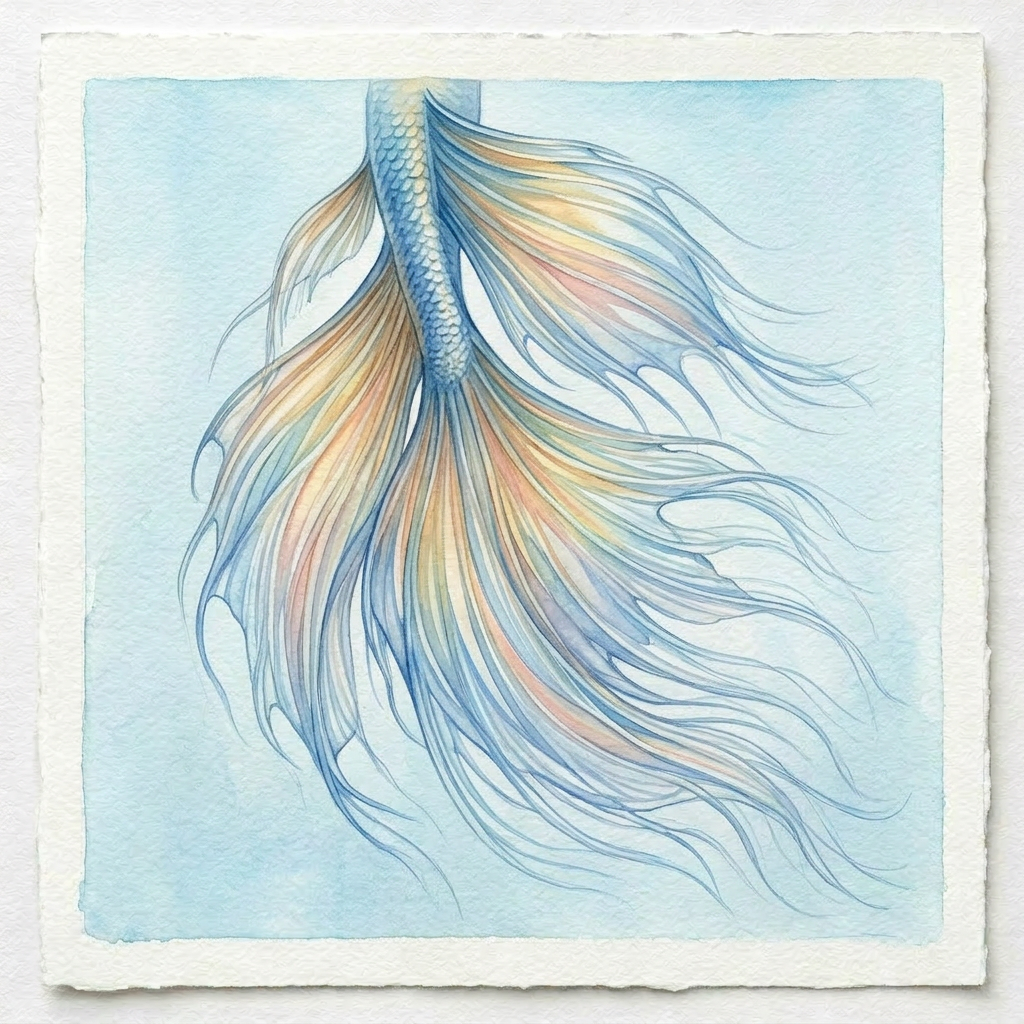
I didn’t want my mother there. But it was lonely sometimes. Until one day, a pearlescent fish sprang out from the water, its scales catching the sunlight and flickering with prisms of color— violet, and mossy green, a flash of honey yellow and ethereal blue. When it jumped, an arc of water trailed behind it like strings of crystal.
At school, I leafed through books to find its name. I colored pictures of the fish for my teacher to identify, but this fish remained unmatched, a mystery every time it broke the river’s surface. It moved unlike any I’d ever seen, so fluid and light, jumping as if it might fly.
I began to dip my feet into the river where it slowed and gathered into pools around my rock. I was hoping to catch the fish’s attention, but it took a long time. Finally, one day, the fish came to me. I marveled at its beauty, its gem-like scales and delicate fins.
“What’s your name?” I asked, but it didn’t respond at first. It was a shy fish. It had taken a week of dipping my toes into the water before it came to me. Finally, though, it answered.
“I don’t have a name,” it said. Its voice was cheerful, like splashing water, the sound of it confirming my budding suspicion that this fish was magic. “How do I get one?”
“Someone gives it to you,” I explained, feeling very wise.
The fish seemed to ponder that, its marble eyes watching me, its mouth a pleasant grin.
“It doesn’t make sense, does it?” it asked. “Why can’t you choose your own name?”
I laughed. The fish was right. And I never liked my own name.
“What do your friends call you?” I asked. The fish swayed in the water, its glowing fins drifting.
“I don’t think I have any,” it said.
Maybe we were very much alike, I thought to myself, even though it was a fish and I was a person.
“Well,” I said. “I’ll be your friend.”
The fish’s eyes sparkled.
I visited everyday, telling it about life on land, and asking about life in the water. I shared the name of the river, Severn, because it had become ours, and I didn’t mind sharing my spot then.
I spent the whole summer running off to the river every chance I could. Sometimes, you would get mad at me for disappearing so much. I thought you just didn’t understand. And how could you?
Then, one scalding summer day, Dad brought Jeffrey fishing in the river.
I woke from a nap and came downstairs to find my fish lying dead and cooked on the dinner table.
Its eyes were gouged out. But I recognized its shape, its once beautifully shining scales charred and covered in spice, its mouth gaping.
I wailed. Murderers. I screamed.
You tried to calm me down. You used to tell me to take a deep breath, and as I let it out, to turn my body in a circle. When I was older, you explained this was a grounding technique to distract from negative emotion. But back then, I didn’t know what that meant. I told you it was stupid. I didn’t want to play your psychology game. I wanted my fish back.
Dad laughed about the whole thing.
“There are plenty more fish in the river,” he said.
When I cried that this one was my friend, Jeffrey made fun of me.
I refused to eat any dinner that night. When the table was cleared I went through the garbage and collected my fish’s skeleton. I brought the bones to my room and whispered to them.
“I’m sorry I was not a good enough friend.” I tasted the salt of my tears as they wet my mouth.
Then, when everyone went to sleep, I snuck out the door and into the woods. The moon was bright and the river glistened with silver. I knelt on my rock and placed the bones into the water.
I tried to talk to my fish how I always did. I wished the bones would reassemble, that its scales would grow back and it would swim again. But nothing happened.
Maybe the water was too cold. I panicked. Maybe I should take the bones back out.
Yellow lights flooded through the trees and behind me, silhouettes of you and dad moved inside the house. Your shadows looked frantic. I ran back so you wouldn’t be worried, but I could hear you yelling at each other from the front porch and wished I stayed with my fish.
That was a year before you divorced. I thought the whole time that it was because of me, because I had made such a big deal about the fish. Jeffrey accused me of such, and years later, even from afar, I still believed it. I shouldn’t have run out in the middle of the night. I shouldn’t have cried so loudly. It was a waste of time anyway. I returned to my spot so many times, hopeful, longing for the beautiful creature that understood me, but it was gone. Its bones lingered for a while like pale ghosts, until they drifted away in the current. No other fish came. The bones must have scared them. Eventually, I grew up and stopped looking. I tried to make other friends, but they often eluded me too.
I was twenty-eight when you died. I returned to that house to try to stop it, but all I could do was watch as it consumed your body. I held your hand as your skin turned yellow, and your bones jabbed out as you gasped for air.
Ruthless disease. It didn’t make sense, to have no cure, to have a problem with no solution. I wanted to save you. And when I couldn’t, I wanted to at least soften it. I remembered your technique of breathing, then turning in a circle during exhalation. But you couldn’t sit up on your own, or breathe without tubes in your nose.
The day before you died, your eyes lit up one final time as I put the useless pills in your palm.
“You were such a happy child.” From that whisper I knew, in one rising moment, your divorce wasn’t my fault.
When you were gone, the arguments resurged. Dad arrived, that blonde he remarried hovering behind him, and decided cremation, even though I told him you wanted a wake and burial. In the end, I helped choose the urn. The services were performed, your long-estranged family from the UK dispersed, and I was left in the empty house surrounded by white lilies in various stages of rot, piles of condolence cards, and empty boxes of pizza.
Jeffrey had listed the house for sale, leaving me to clear everything out. So much to sort, to pack, to throw away, but all I could do was nothing. I stared at the urn, a foreign emblem of you. It looked offensively ugly then, although an urn would be a strange thing to ever call pretty. I passed it everyday that week, the grief pitting inside me like poison, until one evening, when the sun began to fall and cast sparkles over the rippling river, I brought your ashes to the water. I don’t know why. You hadn’t asked me to.
It was a dry summer and the river was thinner than I’d ever seen it.
I stood at my old spot, the rock I wouldn’t let you come to, the name I had carved long since worn away. I poured your ashes into the water where it pooled. I would gladly share my spot with you now.
I lingered there, as you churned then dissipated, the muted sounds of trickling water and rustling leaves echoing the past. The river flowed on as if nothing had changed since then. But there were fewer trees now. Across the river developers had cut some down.
I slipped off my shoes and stepped into the stream beside my rock, the water cool on my toes.
It crashed like a wave, a force both hollow and enormous. My chest tightened and stifled my breath, and my sweat-slicked skin prickled. I crumbled to my knees in panic. I had no Xanax with me.
Just then, the water’s surface broke and a fish jumped from the river, a crystalline trail cascading behind it. Pearlescent scales shimmered in the evening sun. I leapt up, afraid to lose sight of it. But I didn’t have to worry. The fish came to me, swimming by the river bank.
Could it be? I nearly laughed at my foolishness. My memory was foggy from so long ago, buried away with a long forgotten imagination. But it did look the same.
It had the same sheer fins, the same silver tipped scales that had colored my dreams as a child. That fish had seemed bigger though. I guess everything did back then.
The fish didn’t talk. It lingered near me, in the spot where I poured your ashes, the spot where I had left the fish bones in the darkness so many years ago.
Through my water-warped reflection, the fish’s eyes sparkled with sunlight, its fins fluttering, waiting for something, watching me. Then it rose, gently touching the surface with an open mouth, before drifting back.
Deep breath. Then, as if carried by an invisible current, it swam in a circle. Bubbles rose from the fish’s mouth like orbs, breaking the surface between us. Exhale.
I whisper your name.
A calm breeze cools the tears on my face, and one drips into the river that carries you away.
THE END